
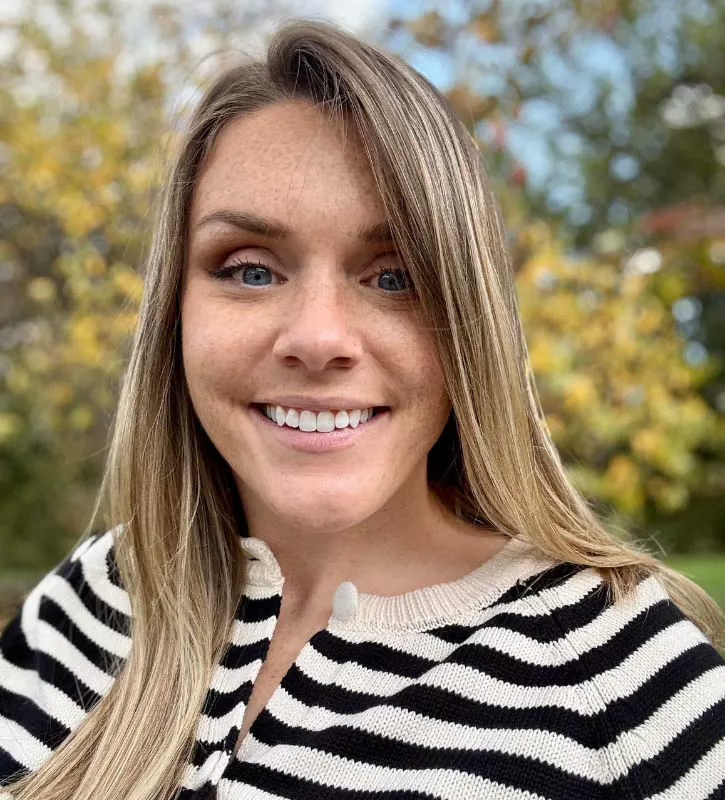
When Claire Senita fell during a routine tumbling class a week after her 14th birthday, the fall broke her neck and changed her life forever.
“When these things happen to people, they just expect everything will be OK,” Senita said. “I was young and thought I’d go to the hospital and would be OK, and then quickly realized that wasn’t the case.”
Now 33, Senita has channeled nearly two decades of lived experience with quadriplegia into leadership roles that are reshaping disability advocacy in Pittsburgh. She recently joined Disability Lead as a 2026 fellow for the organization’s newly established Southwestern Pennsylvania office. She also will continue her role as president of NextStep Pittsburgh, an activity-based training center for people living with paralysis.
Disability Lead, which started in Chicago a decade ago, evaluated several cities and regions before selecting Pittsburgh and Southwestern Pennsylvania for expansion in 2023-24. The organization focuses on connecting leaders with disabilities and placing them in decision-making spaces where perspectives on disability have been historically underrepresented.
“A lot of what we’re doing is based on the reality that people with disabilities are underrepresented in decision-making spaces,” said Jess Grainger, regional director for Disability Lead Southwestern Pennsylvania. “Decisions about people with disabilities often are made about them, not with them.”
Grainger said Senita’s selection as a fellow reflects her extensive development leadership experience and her work identifying gaps in networks of care for people with spinal cord injuries.
“Her work with NextStep Pittsburgh is impressive,” Grainger said. “Claire struck me as someone who had a great deal of development leadership experience already.”
The fellowship program aims to accomplish two primary goals: helping leaders with disabilities connect to strategize and collaborate and expanding the pool of qualified candidates for board and leadership positions. Grainger noted that too often, the same two or three people get asked to fill disability representation roles.
“We’re ready to share those opportunities for people willing to take them,” Grainger said.
For Senita, the fellowship represents an opportunity to meet other disability advocates in Pittsburgh and learn from national disability justice movements.
“I’m excited to get started with the courses in April,” Senita said. “I’m excited to meet the other movers and shakers in Pittsburgh that I haven’t yet met to learn more about them and how we can work collectively.”
Disability Lead’s expansion into Southwestern Pennsylvania addresses specific regional challenges. Allegheny County has 43 different school districts, making it difficult to provide consistent resources for students with disabilities, particularly given recent changes to Section 504 laws.
The region also faces a labor shortage and lacks qualified people for skilled jobs. Grainger said employers want access to talent but often inadvertently screen out people with disabilities through their recruiting, interviewing or accommodation processes.
Disability Lead will measure success through civic leadership broadly, nonprofit boards and professional advancements.
“If I had to bottom line it, we’re here to remind people that people with disabilities deserve to be in leadership spaces and to place people with disabilities in those leadership spaces,” Grainger said. “While accessibility is part of our priorities, what we want to remain at the forefront are the insights and lived experiences of people with disabilities.”
Community members, advocates and organizations can learn more about Disability Lead at their website. Membership for people with disabilities is free. Organizations can explore partnerships to become more accessible and disability-friendly.
Senita’s journey to disability leadership began with significant challenges. After her injury, she received excellent acute care in the medical hub of Pittsburgh. But the continuum of care fell short.
“After that, once you go home, you’re pretty much on your own,” Senita said. “Paralysis is so much more than not being able to walk.”
People living with paralysis can experience issues that quickly become life-threatening. Senita ultimately moved to Boston to receive the ongoing care she needed. The experience exposed systemic gaps that she now works to address in Pittsburgh.
“This is an expensive injury, and a lot of it is not covered by insurance, so that’s a huge barrier,” Senita said, acknowledging that her family has been fortunate to have support from people willing to help.
Pittsburgh’s age as a city presents unique accessibility challenges. Senita said people often incorrectly assume that older buildings are “grandfathered in” and don’t have to comply with the Americans with Disabilities Act.
“That’s simply not true, and that’s where education comes into play,” Senita said. “The majority of people in Pittsburgh want to help, but they just don’t know. There’s also an attitudinal barrier, where people are afraid to ask questions.”
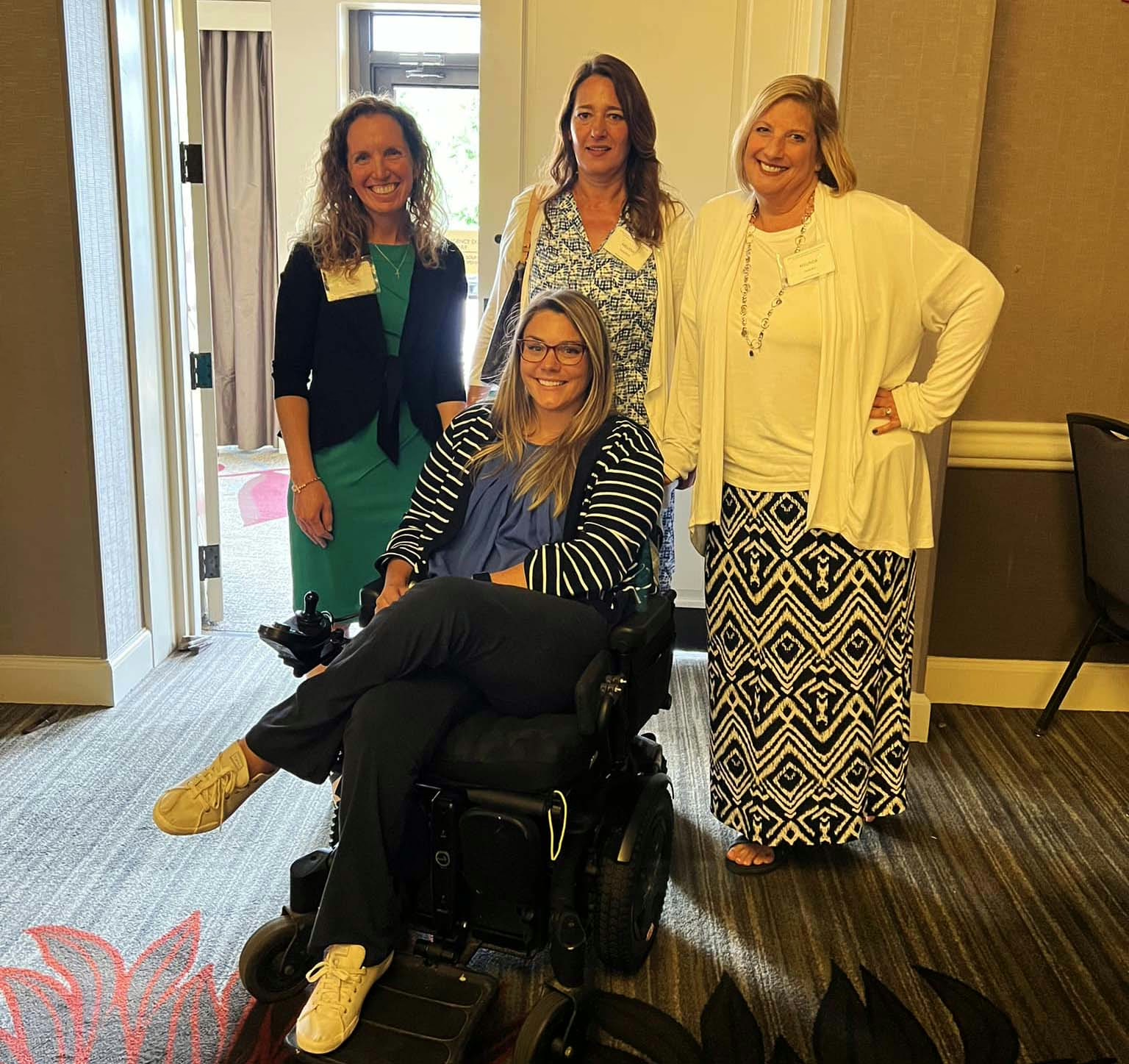
Education and awareness form the core of Senita’s advocacy approach. Through Disability Lead and NextStep Pittsburgh, she focuses particularly on peer education within the paralysis community and across different disability communities.
“I know a lot of people in the paralysis circle in Pittsburgh. Through Disability Lead, I’m excited to meet other disabled persons in the community with other disabilities to learn how to work together,” Senita said.
NextStep Pittsburgh provides activity-based training that follows physical therapy as a continuum of care. The NeuroRecovery Network is among the research organizations that have discovered that through specific tasks and repetitive movements, the body can create neural pathways to achieve a return to function.
When Senita was injured, she spent 10 days in the hospital and two months in rehabilitation learning basic wheelchair skills. Today, rehabilitation typically lasts closer to six weeks. Patients learn essential skills such as sitting up in a wheelchair, pushing themselves around and feeding themselves. However, the long-term healing process requires ongoing support that insurance rarely covers.
“With paralysis, the stereotypical thought is once you’re paralyzed, that’s it. It’s permanent,” Senita said. “Healing is possible, but it’s a very long process and insurance doesn’t cover it.”
Many people with spinal cord injuries end up isolated at home. Transportation barriers compound the problem, as wheelchair-accessible vehicles are expensive. Many people can’t afford them.
“There’s not a good system for peer support and building a relationship right after injury,” Senita said.
Activity-based training reduces secondary issues such as bed sores and muscle retraction while building community. People with spinal cord injuries can gather in the same place to work out together while forming meaningful relationships and support networks.
Senita organized a support and social group for women with spinal cord injuries. When they learn about newly injured women, they reach out to offer support. “It’s a small community of people who can understand,” Senita said. “After I got hurt, I didn’t really have that. I don’t want other people to be alone and suffer. If I can turn this into something good, I want to do that.”
Senita’s leadership philosophy centers on visibility and presence across sectors, including the arts, business and healthcare. “I honestly think it’s just showing up,” Senita said. “A lot of times, I’m the only person in the room with a visible disability. It’s showing up and showing that I’m a well-rounded person with different interests. I have a disability, but I’m still a person.”
She views her disability as an asset that provides a unique perspective on community needs.
“It definitely gives me a different perspective,” Senita said. “You don’t know what it’s like until it happens to you. There’s a lot of power in using your voice. This is something that could happen to anybody at any time. Raising awareness and trying to create change for what is needed betters the community for people who may not even know they’ll need it someday.”
Funding disability-focused programs has been a learning experience. As a nonprofit, NextStep Pittsburgh is eligible to receive grants, and Senita has discovered many disability-focused organizations are willing to help.
“This is what I love about Pittsburgh,” Senita said. “Yeah, we’re behind on some things, but different organizations and individuals want to help, whether that’s financially or through other support.”
Insurance doesn’t cover NextStep services, and the organization doesn’t want anyone to miss receiving care because they can’t afford it. Senita recently received her first grant for NextStep, and the organization is close to opening. They are searching for a space on the outskirts of the city that is centrally located and easily accessible from major highways.
Her advocacy work extends to the legislative level. Senita served on the Pennsylvania Rehabilitation Council, which advises the Office of Vocational Rehabilitation. She traveled to the state capital to meet with legislators.
“Talking with them made me realize that some of them have no idea what’s happening with problems related to disability,” Senita said. “Awareness for the lawmakers who can make these changes is a big component of reform.”
Donations to NextStep Pittsburgh can be made through the organization’s website. NextStep also has a Night at the Races fundraising event on March 6 at The Camelot in Wexford.
As Senita prepares for her fellowship courses beginning in April, she remains focused on the immediate goal of opening NextStep Pittsburgh while building connections across disability communities.
For people living with paralysis in Pittsburgh who may feel isolated or overlooked, Senita offers encouragement grounded in her own experience.
“Give yourself grace to feel what you need to feel, but don’t live there,” Senita said. “Life is not over just because of this. There’s still so much potential in life, and what you do in life can still be meaningful. You can still be a productive member of society.”